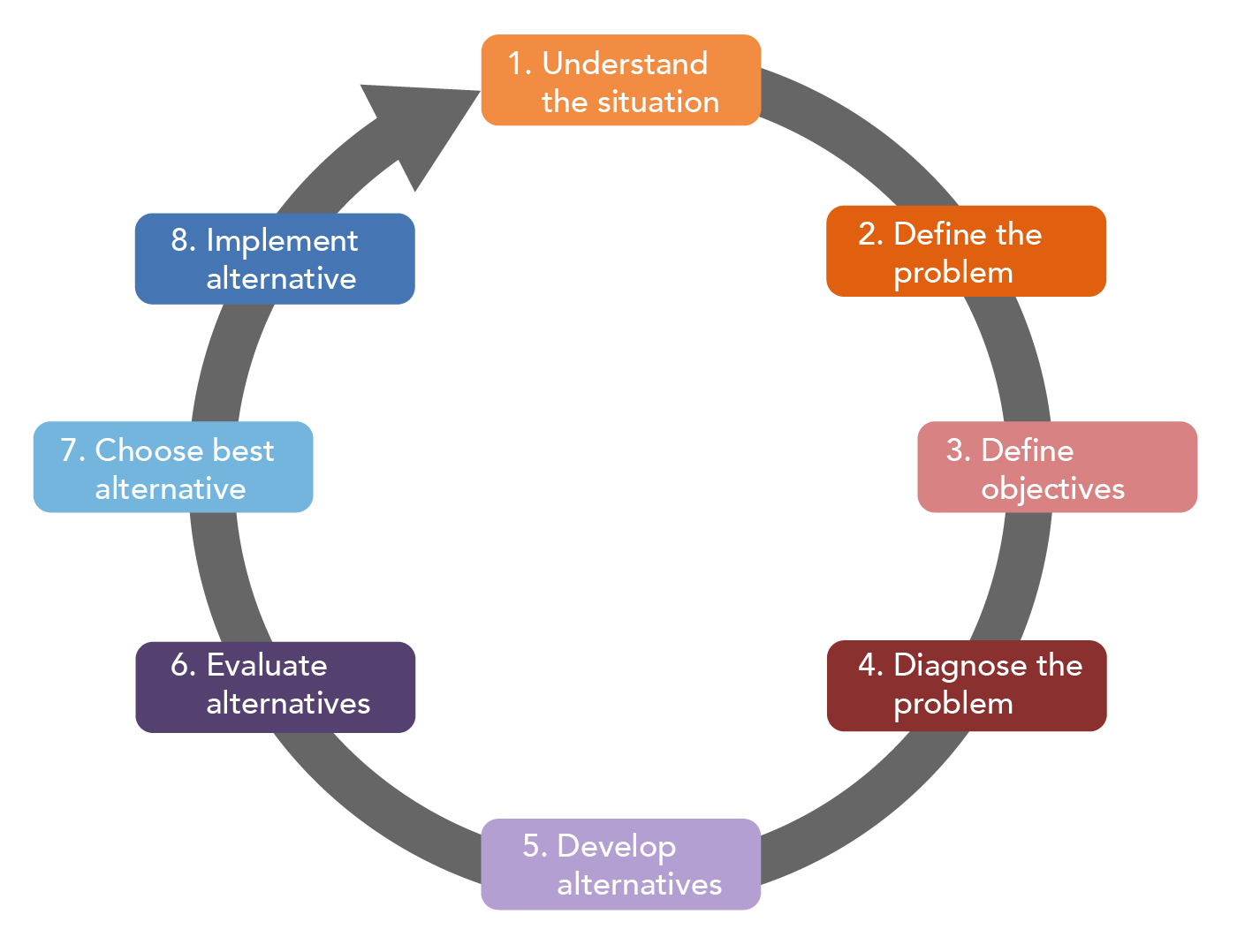
Routine, repetitive decisions, an organization develops a specific process for handling them. (i) based on habit (ii) critical routine standard operating procedure.
12.2 Making Decisions in Different Organizations Organizational Behavior
It is the basic activity of the management.
Organizational decision making definition. Organizational decision making magazine article. An organizational decision making is a series of professional decisions that a company undergo for its success. When analyzing problems or situations, decision making is the process that a person or a group does to evaluate solutions and alternatives to choose the most rational option.
Decision making refers to making choices among alternative courses of action—which may also include inaction. The consequences of ineffective organizational decision making can be dire. Routine and strategic decisions 4.
It is the responsibility of business managers to make operational decisions and ensure that their teams execute the tasks. In an organizational context, it is worthwhile to note that decision making needs the right kind of information, the complete information and the ability to synthesize and make sense of the information. This article throws light upon the seven different types of decision taken in an organization.
Information and translations of decision making, organizational in the most comprehensive dictionary definitions resource on the web. On the other hand, perfect organizational decision making turns the. Decision making is a fundamental function of the management.
No organization design or method of management is perfect. And any form can suffer from a variety of problems. It helps in identifying and defining problems.
In present made decisions define how will be the organization in the future. Institute of information security (iis) decision making. Policy and operating decisions 5.
This observation is a statement of both structural and operational fact: It reflects the success and failure of the management and the organization which mainly hinges upon the quality of decisions. During the planning stage, managers need to make various decisions.
Personal and organizational decisions 6. It is an indispensable part of the management, as decisions are made at each level by the management executives. Every organization runs by operating decisions.
It is a rational and scientific method of choosing the best option. The decision making role of the management is the ‘heart’ of the executive activities in the organization. Organizational and individual decision making — 1 — organizations do not make decisions, people do.
Meaning of decision making, organizational. Major and minor decisions 3. Definition of decision making, organizational in the definitions.net dictionary.
Organizations (as physical realities, not accounting or legal entities) are made by, and are comprised of, people. While the first two attributes depend on external sources, the ability to make informed decisions is a personality trait. 8 because of this, many organizations remain effectively stuck in neutral, with.
Decision making is the process of formulating resolutions within the scope of influence. It is also known as the heart of management. Type of decision making traditional technique modern technique 1.programmed:
Therefore, increasing effectiveness in decision. As such, decision making process can be further exemplified in the backdrop of the following definitions. While it can be argued that management is decision making, half of the decisions made by managers within organizations ultimately fail (ireland & miller, 2004;
Explore the definition and application of this method in six steps: It could be either rational or irrational. Limitations of managerial planning and decision planning.
There may be transportation, transformation, Decision making is the cognitive process of selecting a course of action, out of a set of available alternatives, so as to achieve the goals of the organization.
The four above needs are literally the difference between living and dying. This includes the need for oxygen, water, and food.

Maslow's Hierarchy of Needs Why It Still Matters In 2020
Although later research does not fully support all of.

Hierarchy of needs definition. In the hierarchy of needs, basic needs should be met first. It deals with getting recognition, self respect in the society. In his essay “a theory of human motivation,” first published in 1943 in the academic journal psychological review and subsequently included in maslow’s book motivation and personality (1954), he defined a hierarchy of human needs which in his assertion motivate the behavior of all people.often represented as a pyramid, this.
According to maslow, we have five categories of needs: Examples include air, food, water, shelter,. Maslow’s hierarchy of needs is distributed into 5 levels:
Needs at each level of thehierarchy must be met before the next level can be achieved. This theory further states that the most basic level of need strengthens the desire in human personality. All these four needs are required to match the fundamental requirement of a human being.
If you do an image search, you’ll find a plethora of creative endeavours trying to represent his pyramid (and i’m not claiming the one on this page is the best!). Includes biological requirements for human survival. According to the theory, maslow explains that there are four needs like.
The hierarchy of needs is a psychological idea and also an assessment tool, particularly in education, healthcare and social work. List of maslow’s hierarchy of needs (from most basic to most advanced) i. What is the hierarchy of needs?
| meaning, pronunciation, translations and examples The need for recognition and acceptance arises when a person has fulfilled their need for love and belongingness. These are the things that most, if not all, organisms need to survive, such as the ability to breathe, stay warm enough or cool enough, get sleep when we.
Includes emotional security, financial security, law and order, freedom from fear, social stability. Needs range fromthe bottom level ofphysiological (e.g. Forming the base are the physiological needs that are essential for survival.
With this definition, it is simple to understand where maslow’s pyramid fits into this equation. Hierarchy of needs description * * the full technique overview will be available soon. The concept was introduced by abraham maslow in his 1943 paper “a theory of human motivation” in the journal psychological revie.
Maslow's modelof basic human motives, which he saw as organised in a hierarchical structure; In many theoretical views, motivation is defined as the joining of the will with actions or behaviors , in order to satisfy a need. This slightly clunky phrase simply means that humans want to feel that they are fulfilling their potential and making the most of their abilities.
This is the lowest and most basic level of maslow's hierarchy. The levels of the hierarchy, starting from the base of the pyramid are: If you look up ‘maslow hierarchy of needs’ you’ll be overwhelmed by the many links, information, misinformation, interpretations and misinterpretations you can find.
The second level is composed of safety and security. This is considered as the fourth level of the hierarchy of needs theory. The hierarchy of needs is often used both to explain and to incite motivation in individuals.
The hierarchy remains a popular framework in sociology research, including management training and higher education. What is the hierarchy of needs? It is related to the need of a person being recognised in the society.
A robust way to conceptualize needs is through maslow’s hierarchy of needs (1943). The hierarchy of needs is often presented as a pyramid. Maslow’s hierarchy of needs is a framework for understanding human needs arranged as a hierarchy.
It is usually represented as a pyramid with the more basic needs at the bottom. In this theory, higher needs in the hierarchy begin to emerge when people feel they have sufficiently satisfied the previous need. The hierarchy of needs is a characterization of an individual’s needs, as classified by abraham maslow in his 1943 research paper, a theory of human motivation.
The hierarchy of needs is used to study how humans intrinsically partake in behavioral motivation. A hierarchy is a system of organizing people into different ranks or levels of importance.
Managers must select the right people for the right jobs, and assign them tasks that suit their skills and abilities. How to improve delegation skills.
How to make Delegation effective

Agent, ambassador, emissary, envoy, legate, minister, representative, assignee;

Ability to delegate definition. It is important to remember that qualifications influence the nature of the authority delegated. To ensure you’re delegating effectively, you’ll also want to ask your team for any feedback that they can give you. You need to listen to any questions or concerns of your employee, and make sure he or she understands your expectations.
It is the process of distributing and entrusting work to another person, and therefore one of the core concepts of management leadership.the process involves managers deciding which work they should do themselves and which work should be. Select the person in the light of the job to be done. A member of a house.
Delegation types and skills for delegation examples. Delegate synonyms, delegate pronunciation, delegate translation, english dictionary definition of delegate. When you delegate tasks, you reduce your workload while retaining responsibility.
This is the purpose of the managerial function of staffing. You can start by evaluating your delegation skills to determine what qualities to improve. A person authorized to act as representative for another;
Employees know what is expected and what has to be done. The meaning of delegate is a person acting for another. For example, a task to audit the security of a database might be critical to implementing a new content management system.
It remains the managers responsibility to ensure each employee plays their part. The ability to wisely and effectively delegate is a quality far more quiet than others, and yet one of the most crucial to a leader’s success. Delegating is one of the core responsibilities of a leader, but it can be tricky to delegate effectively.
Have measurable outcomes for the task in relation to the project. Be sure the task fits in with the project goals. Definition of delegation from the regulations, 712 nac 99, the competency to accept the delegation?
It is the description of the role assigned to the subordinate. Delegation is the assignment of authority to another person (normally from a manager to a subordinate) to carry out specific activities. Delegation involves following three elements:
The superior asks his subordinate to perform a particular task in a given period of time. Delegation involves assigning tasks you have responsibility for to your coworkers or team members. That method can be used in a delegate for a sort algorithm.
By clearly describing his or her idea to their team, the leader will be able to create a sense of ease and understanding with his or her peers. This ability to refer to a method as a parameter makes delegates ideal for defining callback methods. Delegation of authority may be specific or general.
How to use delegate in a sentence. Because the comparison code is separate from the library, the sort method can be more general. Define assignments and delegate authority in the light of results expected.
The extent of authority to be delegated depends upon several factors, like the ability and willingness of the executive to delegate, the ability of the subordinates to accept delegation, the confidence of the superior in his subordinates, the philosophy of management, etc. Ask your employees if you provided clear instructions and determine if there’s anything you can do to better delegate in. A representative to a conference or convention.
Representative, as in a political convention. Delegate definition, a person designated to act for or represent another or others; The ability to delegate is crucial to the success of any team as it leads to enhanced collaboration and greater participation from team members.
When managers delegate they provide a framework and structure for employees. Whether you’re a manager at work, owner of your own business, officer in the military, or simply working on a school project, effective delegation is one of the keys to achieving your goals. So, how to delegate effectively should be a skill that organizations should consciously promote.
When every member of the team is striving towards a common goal, then there is. When working out whether a worker is an employee or contractor, one factor to consider is whether the agreement or contract gives the worker the right to pay another person to do the work instead of them. Listening is also an important communication skill to use when delegating.
First, decide on the task or responsibility you want to delegate. Having the ability to delegate effectively will certainly get the respect of employee, and encourage employee to perform the task to the. What’s important is to define the scope task, both verbally and in writing.
The first step in delegation is the assignment of work or duty to the subordinate i.e. Maintain open lines of communication. Learning more about delegation can help you improve delegation practices in your organization.
The agreement or contract your business has with the worker can be in writing or verbal. The ability to manage efficiently and effectively is therefore dependent one’s ability to delegate. According to murdock and scutt (2001) the definition of management is getting work done through people.
You can write a method that compares two objects in your application. The goal isn’t just to free yourself up — it’s also to enable your direct reports, facilitate teamwork, provide autonomy, lead to better. All of this requires clear, effective oral and written communication skills.